WorkEm Blog

We blog to share our story about Working Together, Interweaving, and Modern Work-oriented Architecting. By sharing we can inform and encourage discussions and collaborations on the Interweaved world, we all belong to.

Step b) of Reimagining The Business Model Canvas for Triple-Bottom-Line

b. What if we, add value streams and treat partners as part of an extended enterprise? In this transformation, we first add or rather make visible the underlying value stream or the end-to-end collection of activities that create a result for or satisfy the customers. A value chain links together up-stream partner activities with a company's activi...

Continue reading

Step c) of Reimagining The Business Model Canvas for Triple-Bottom-Line

c. What if we, add customers jobs-to be and macro structures? In this transformation, we balance the interweaved Business Model Canvas in two ways. Firstly, we add "Key Customer Activities" and "Key Customer Resources" themes in addition to "Customer Segment(s)" to match the organisation's and partner's activities and resources.Secondly, we add a "...

Continue reading

Step d) of Reimagining The Business Model Canvas for Triple-Bottom-Line

d. What if we add enablers and means? In this Transformation, we add the concept of "Enabler" to the "Key Resources" theme. Enable: This opens up discussions about key elements that are means, help, support, facilitate or enable the organisation in focus to create and sustain value.  This is in addition to having access to or own and use resou...

Continue reading

Missing Triple-Bottom-Line Using The Business Model Canvas?

Business-Design-Practice---What-if---iBMC---3

The popular Business Model Canvas (BMC) from 2005 by Alexander Osterwalder et al. offers a basic tool for discussing business models. It is often used in workshops where it provides simplicity for people who do not typically develop business models. The simplicity comes with a price; it is easy to fall off the canvas when discussing aspects related...

Continue reading

EU Digital Product Passport (DPP) is a breakthrough program ...

The EU Digital Product Passport (DPP) is a breakthrough program to promote sustainability, transparency, and circularity in the product lifecycle—it's more than just another regulatory mandate. By enabling the interchange of sustainability information across value chains, the DPP is positioned to play a crucial role in enabling creative approaches ...

Continue reading

The greening of Europe, the Digital Product Passport

The Digital Product Passport (DPP) is an enabler for the greeing of Europe. The DPP provides a crucial building block for transparent product and supply chains. I you want to know more then let us know.

Att sätta fart på digitaliseringen i offentlig sektor

Digitaliseringen i offentlig offentlig sektor är viktig men har fortfarande många utmaningar att ta sig igenom eller runt.En av dom är digital samverkan genom säkert och tillitsfullt utbyte av digitala meddelanden. Till exempel för att ersätta faxen. I en serie artiklar kommer jag att berätta om ett nytt medel för digital samverkan - PLATTFORMEN FÖ...

Continue reading

Hur kan SGSI, Plattformen och SDK-federationen integreras?

Detta är en platshållare för en framtida artikel om hur SGSI, Plattformen för eDelivery och SDK-federationen passar ihop. Teaser:De tre kompletterar varandra, dvs de ersätter inte varandra. Den enklaste integrationen mellan de tre är att skapa an ny SGS-federation med speciella regler för styrning och ledning, deltagande, säkerhet och tillit, trans...

Continue reading

Plattformen för Säkert och Tillitsfullt Utbyte av Digitala Meddelande i Gemenskaper (STUDMIG)

Innehållsförteckning Hur en plattform som STUDMIG är uppbyggd och varför?Hur skapas nyttor skapas och var det det finns nätverkseffekter, för vem?Hur kan ledtider signifikant förkortas för utveckling och införande av samverkansuppdrag?Vad är skillnaden mellan en Plattform, Infrastruktur, Byggblock och Specifikation.Vad är nödvändig variation och on...

Continue reading

A Learning perspective of Digital Transformations

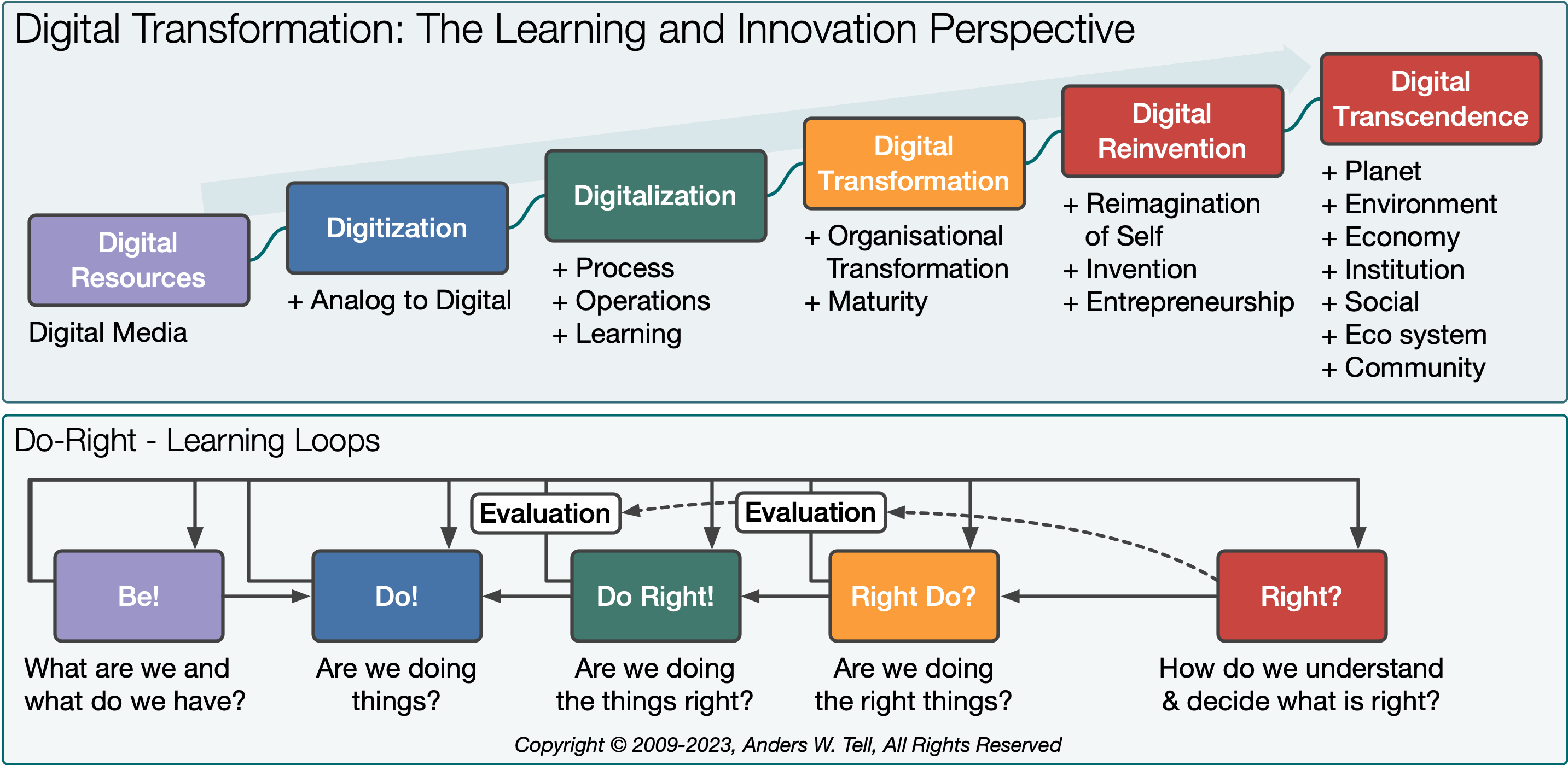
A Learning perspective of Digital Transformations provides a pedagogical tool for discussions about the nature of digital transformation projects. However, many projects include Digitisation, Digitisation, and Digital Transformation elements. This perspective brings to the surface focused definitions of related words and phrases such as digitisatio...

Continue reading

Asymmetrical Information Production

Have you encountered this situation? When someone makes a presentation or gives you a model, you simply cannot understand what to do with it. Unfortunately, it is quite common, especially when the producer uses a well-defined method. Here the method provides the answers even before the questions are asked.It is also common that the producer really ...

Continue reading

Where Are They? The Strategy, Design, Architecture, and Interweave?

Some say, they exist in documents, specifications or plans. Some say, they exist out there in the real world. Others say no, one cannot find them in the wild. This is a topic that Interweaving often works with. Instead of accepting unnecessary and often disrupting opposing points of views, Interweaving shift focus from "either/or" to "and" through ...

Continue reading

What is Design vs. Architecture? According to whom?

Well, the answer typically depends on who is asked since there are many views and positioning of others. Amongst the opinionated, we find the following roles or professions. • Business executives, managers, and specialists • Designers • Business Designers • Service Designers • Business Architects (BA • Enterprise Architects (EA) ⁃ System Architect,...

Continue reading

Explaining Design Thinking - Distinctions that matter

The Design Thinking approach (DT) to design, innovation, and problem-solving has been around for a long time in the design community. DT is gaining traction in new fields, such as developing societies, strategies, and businesses. Non-designers have also started to embrace DT. The wider applications and experiences gained from using Design Thinking ...

Continue reading

The Balance between Stakeholders and Architects

In interweaved Enterprise Architecture (iEA) we encourage the understanding and balanced accommodations between the participating stakeholders and architects and the work they do with others. They all have to listen to each other. If stakeholders see little use for architectural products, the architects should listen to why, and stakeholders should...

Continue reading

interweaved Design Diamond (1) - The Start

Diamond (DDD) is started as introduced in "What If We Redesign The (Double) Design Diamond To Become Interweaved?" What if we redesign the Design Diamond? The goal is to create new knowledge and explore how essential aspects of Design can be represented in a diamond form. The resulting interweaved Design Diamond (iDD) provides an explanatory schema...

Continue reading

What If We Redesign The (Double) Design Diamond To Become Interweaved?

The seed: The 'Double Design Diamond" (DDD) is a popular way to describe and orient what design is and how design is done. One of the most important features of the DDD is that it is visually appealing and is used as a baseline for describing a design process. The British Design Council even claims it is universally accepted, Design Council. But is...

Continue reading

Boost your designs with the Affordance Canvas

Power up your designs using the Affordance Canvas to make the most of the possibilities in the age of crisis and Corona. The Affordance Canvas results from the effort to enrich design thinking using Interweaving. How:- After the team has formulated a problem point-of-view and found a solution, the team turns around and explores the affordance of th...

Continue reading

Design Thinking - is that all?

A debate is raging about whether design thinking is the same as design. A quick overview of the field reveals quite a few popular design and service thinking approaches that, to a degree, are similar. They all present a graphical overview of a simple method with 5-8 steps, including problem-finding and solution creation. But is that all there is? I...

Continue reading

Is Design a process or moves

There is an interesting relationship between design and dance. In dance, beginners start out by learning basic patterns. Just as is the case with design thinking and service design, where the simple and appealing 5, 6 or 7-step processes from books, universities and famous companies lure participants into enjoying design. Both beginner dancers and ...

Continue reading

By accepting you will be accessing a service provided by a third-party external to https://www.workem.com/

Contact:
WorkEm Toolsmiths
info AT workem.com
+46 768 790730
+49 152 2241 0640

Locations:
Munich
Milano