

WorkEm Blog
Beyond Blueprints - Manifestations: Three Manifestations of Strategy, Design, Architecture, and Interweave
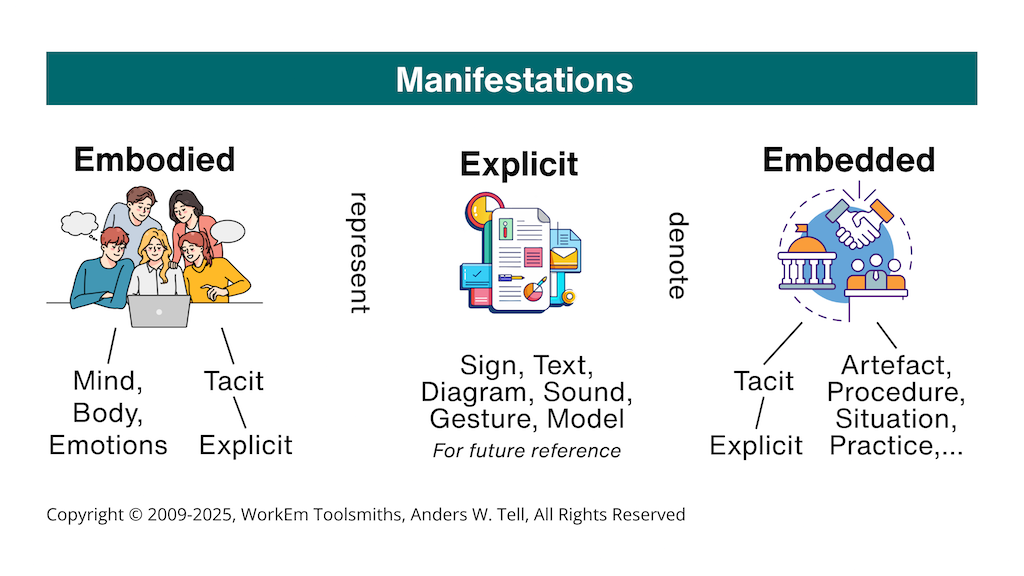
When we think of strategy, architecture, or design, we often picture tangible outputs: the detailed strategic plan in a binder, the architectural blueprint, or the final design model. However, these documents represent only a fraction of the total knowledge. The real substance of any strategic or design initiative exists in multiple forms, often unseen and unapparent.
Consider what happens in practice: Those who participate in strategy sessions or design reviews know far more than what appears in the final documents. They understand the reasoning behind decisions, the options explored and rejected, the trade-offs debated, and the compromises reached. Similarly, a building may start according to specifications, but over time it evolves—adapted by its users, shaped by wear, and modified to meet changing needs. Strategic plans translate into patterns of decisions and behaviours, some deliberate, others emerging from organisational culture and unforeseen circumstances.
To truly grasp and leverage strategy, design, architecture, and Interweave, we must first recognise three distinct manifestations: Explicit, Embodied, and Embedded. These are complemented by two further dimensions — the attitudes of agents toward their work, and the modalities through which knowledge passes — which are explored in companion articles.
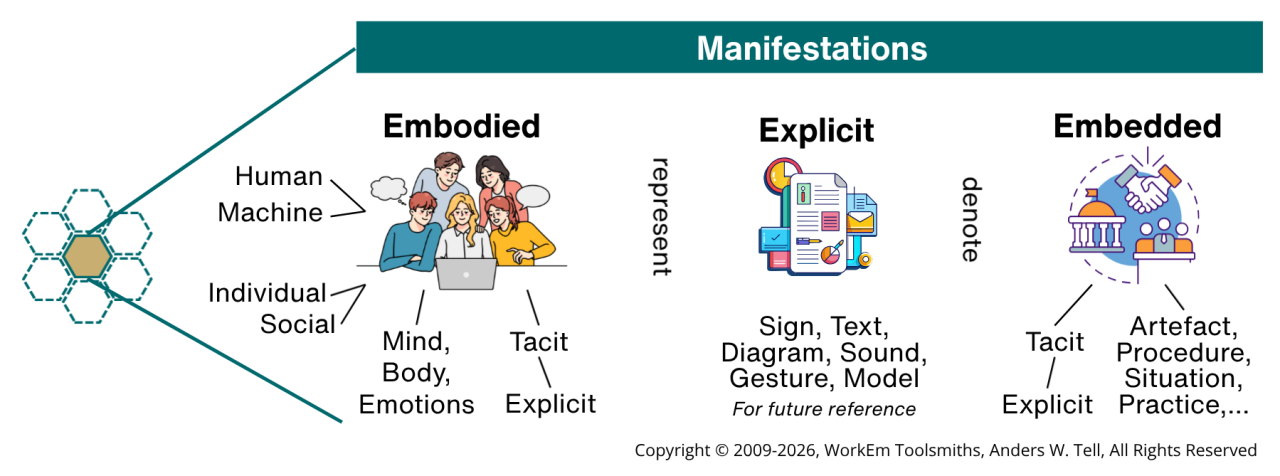
1. Explicit Manifestation: The Documented Foundation
This is the most familiar form of manifestation. It is what has been deliberately made explicit, articulated, codified, and stored for others to access and reference in the future. It is intended to be clear, transferable, and unambiguous.
- What it is: Knowledge that can be made explicit, written down, drawn, or modelled. It is tangible and can be shared efficiently among people and machines.
- Where you find it: Strategic plans, business process models, architectural blueprints, financial reports, design specifications, software code, and user manuals.
- Why it matters: Explicit knowledge enables communicability, scalability, consistency, and continuity. It allows organisations to preserve insights, onboard new members, ensure compliance, and maintain alignment across distributed teams. As many have learned the hard way, relying solely on explicit documentation and instructions is insufficient—the real-world outcome isn't determined by documentation alone.
2. Embodied Manifestation: The Knowledge and Wisdom in Agents
This is the intuitive, experience-based manifestation that resides within individuals, teams, and social contexts in their minds, bodies, and emotions. It is the "know-how" that is difficult to write down, externalise, and socialise, but is critical for execution, innovation, and problem-solving.
- What it is: The expertise, intuition, and unspoken understanding of people. It includes tacit and implicit knowledge, which is created and transformed through learning, reflection, and direct experience.
- Where you find it:
- A seasoned strategist's "gut feeling" about a market shift.
- An architect's intuitive sense of space, light, and flow.
- A designer's feel for what will resonate with users.
- A craftsperson's physical skill in working with materials.
- The collective wisdom of a team that understands the "why" behind decisions, including debated options and discarded variants in meetings.
- Strong emotions from success or hardships.
- The unspoken shared mental models that drive innovative problem-solving.
- Why it matters: This is the knowledge that enables rapid judgements (System 1) or deep thoughts (System 2), sees connections others miss, and innovates beyond established frameworks. It is developed through mentorship, collaboration, and doing the work. Nonaka and Takeuchi's SECI model — Socialisation, Externalisation, Combination, Internalisation — describes the cycle through which embodied knowledge becomes explicit and explicit knowledge becomes embodied again. It is often lost when team members leave an organisation. Without aligning individual and social insights with documented plans, even the most well-thought-out strategy can perish in practice.
3. Embedded Manifestation: The Systemic Reality
This manifestation is an integral part of a specific portion of reality, such as an organisation, a product, or a physical environment. It exists in processes, procedures, workflows, cultural norms, day-to-day operations, and the design of artefacts themselves, shaping behaviour and outcomes, often unconsciously.
- What it is: Manifestations in routines, practices, objects, or spaces. It can be the result of deliberate design or can emerge organically over time. It is often invisible until disrupted or changed, and shapes behaviour through constraints and affordances.
- Where you find it:
- An office layout that naturally encourages collaboration between specific teams.
- A company's ingrained "agile" meeting culture that dictates how decisions are made.
- The design of a software interface that guides user behaviour without explicit instructions.
- A building that, through years of use, has been subtly modified by its inhabitants, deviating from its original blueprints to suit their needs better.
- The unwritten rules of how things actually get done.
- Why it matters: Embedded manifestation is strategy and architecture in action. It is what people encounter in their daily work—the structures and systems that shape behaviour, enable or constrain possibilities, and ultimately determine whether explicit strategies and designs achieve their intended outcomes. Changing a process, for instance, often requires more than revising the documentation—it means reshaping actual routines and structures that people have internalised and committed to.
Why This Matters
Here is the reality: a brilliant strategy document means nothing if people do not understand it intuitively or if organisational systems work against it. Success requires all three manifestations working together.
We have all seen it happen. A beautifully crafted strategy fails because it clashes with how people actually think and work. A new process gets documented but never adopted because it conflicts with established routines. An elegant design sits unused because the team's hard-won experience was ignored in its creation.
The pattern is clear: explicit plans only succeed when they align with people's instincts and experience, and when they are embedded into the structures and systems that guide daily work. Miss either piece, and you get the frustrating gap between "what we said we'd do" and "what actually happened."
This is not about choosing between documentation, expertise, and practice—it is about recognising that they are inseparable. The strategist who only writes plans, the architect who only draws models, the designer who only creates specifications—they are all missing the larger picture.
In summary, while blueprints and manuals are undeniably important, the real craft lies in harmonising them with the tacit insights of skilled individuals and the systemic patterns that shape everyday decisions. This holistic and interwoven view—integrating explicit, embodied, and embedded manifestations—forms the backbone of truly effective strategy, architecture, and design.
These three manifestations are not the complete picture. The Interweaving Lens — the analytical framework at the heart of Interweave practice — formalises manifestation as Facet 6, one of seven facets that together determine what qualifies as architectural knowledge and how to work with it. The Lens also addresses how knowledge evolves over time and how it is curated for use. Two further dimensions complete the vocabulary: the attitudes that agents hold toward strategy, design, architecture, and Interweave — whether they believe it, intend it, or commit to it — and the modalities through which it passes, from considered possibility to actual reality to generative potential. These are explored in two companion articles in this series.
Anders W. Tell — Senior Enterprise Architect and Master Interweaver
When you subscribe to the blog, we will send you an e-mail when there are new updates on the site so you wouldn't miss them.
About the author

By accepting you will be accessing a service provided by a third-party external to http://www.workem.com/
Comments