One of the design qualities that design projects should consider is what changes in a solution, artefact or service are anticipated. Or, how should they evolve over time?This quality is often called the mutability or changeability of a solution. Both concern the inherent capacity of a design to be changed, adapted to changes, extended, modified and...


Insights & Articles
Blog
WorkEm help you improve who you are, what you do and what you aspire to.

The Work-Oriented Approach (to Information Products) (WOA) is a research-based method that addresses information production and consumption.The focus is on individuals' use and organisations' co-use of information such as reports, studies and models to increase organisations' aggregate utility and improve stakeholder values and economic, social and...
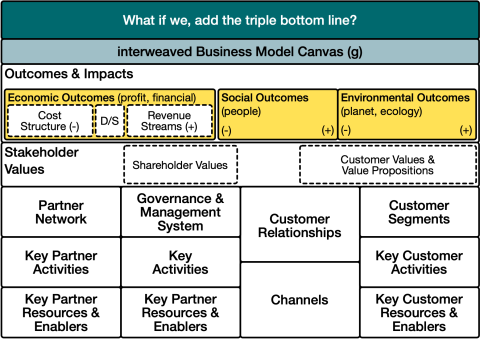
In this transformation, we introduce the concept of Triple Bottom Line into the iBMC. The central idea behind the Triple Bottom Line is that organisations should evaluate their performance from a broader perspective, including their social and environmental impacts, in addition to their economic performance—rather than focusing on generating profit...
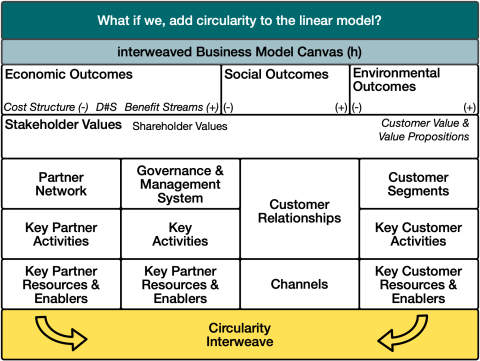
In this transformation, we introduce the concept of Circular Economy into the up until now the linear iBMC. More to come soon. . The full article is found here:
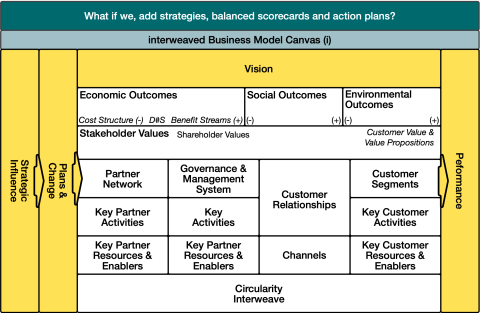
In this transformation, we introduce the concept of Strategy to the iBMC. More to come soon. . The full article is found here:
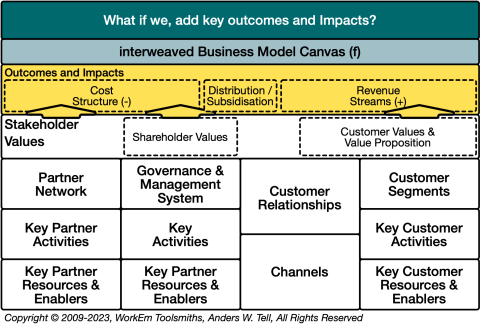
In this transformation, we generalise the concepts of "Cost Structure" and "Revenue Streams" into an "Outcomes and Impacts" theme and introduce the concepts of "Distribution" and "Subsidisation". Enabling: This opens up discussions about different kinds of positive (+) and negative (-) outcomes and impacts that are considered relevant and that stak...
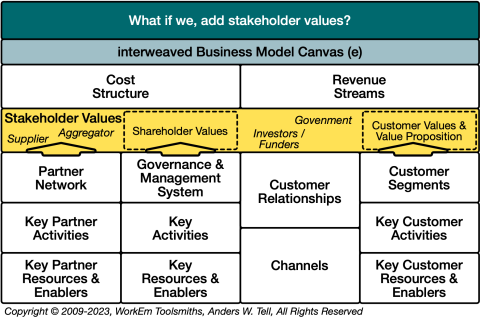
In this transformation, we generalise the concept of "Value Proposition" into "Stakeholder Values" that are moved up the Value Ladder into a position above the organisation, partners and customer. Enable: This opens up discussions about values and benefits for more stakeholders than the customers. Interweave: The broadening of "Value Propositions" ...
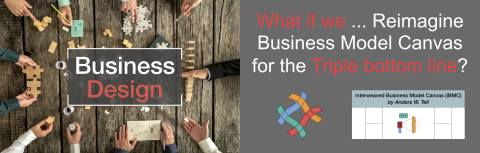
The popular Business Model Canvas (BMC) from 2005 by Alexander Osterwalder et al. offers a basic tool for discussing business models. It is often used in workshops where it provides simplicity for people who do not typically develop business models. The simplicity comes with a price; it is easy to fall off the canvas when discussing deeper aspects ...
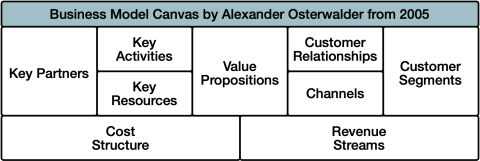
0. The starting point: Business Model Canvas The starting point and baseline is the well-known Business Model Canvas (BMC) from 2005 by Alexander Osterwalder, as illustrated in the book "Business Model Generation" from 2010. he canvas contains 9 parts that are translated into 9 themes and talking points using the Bricks and Mortars practice. We lea...
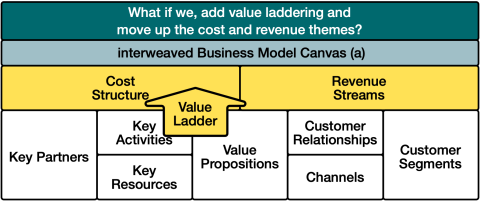
a. What if we, add value laddering and move up the cost and revenue themes? In this first transformation, we make a seemingly trivial change by moving the cost structure and revenue streams up to the top of the canvas. This graphical change introduces something that later will be proven to be important: value-laddering. A value ladder links differe...
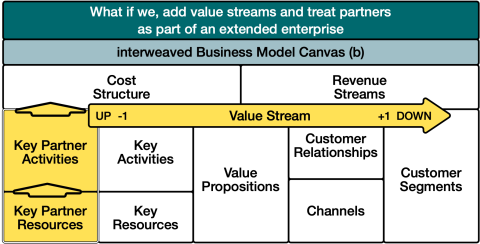
b. What if we, add value streams and treat partners as part of an extended enterprise? In this transformation, we first add or rather make visible the underlying value stream or the end-to-end collection of activities that create a result for or satisfy the customers. A value chain links together up-stream partner activities with a company's activi...
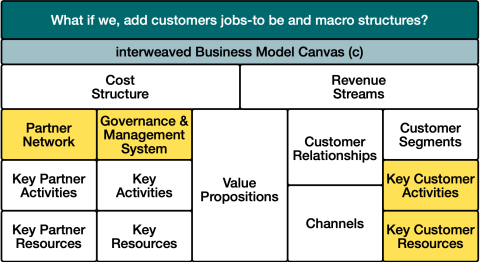
c. What if we, add customers jobs-to be and macro structures? In this transformation, we balance the interweaved Business Model Canvas in two ways. Firstly, we add "Key Customer Activities" and "Key Customer Resources" themes in addition to "Customer Segment(s)" to match the organisation's and partner's activities and resources.Secondly, we add a "...
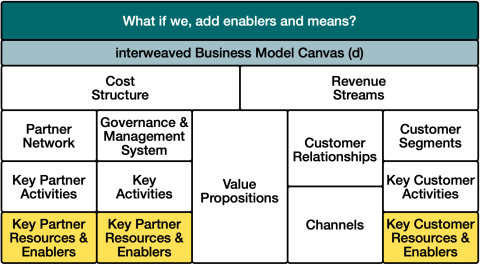
d. What if we add enablers and means? In this Transformation, we add the concept of "Enabler" to the "Key Resources" theme. Enable: This opens up discussions about key elements that are means, help, support, facilitate or enable the organisation in focus to create and sustain value. This is in addition to having access to or own and use resou...
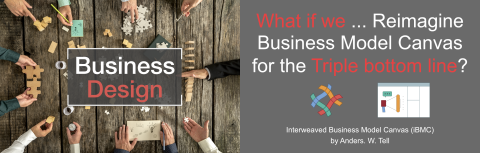
The popular Business Model Canvas (BMC) from 2005 by Alexander Osterwalder et al. offers a basic tool for discussing business models. It is often used in workshops where it provides simplicity for people who do not typically develop business models. The simplicity comes with a price; it is easy to fall off the canvas when discussing aspects related...

The EU Digital Product Passport (DPP) is a breakthrough program to promote sustainability, transparency, and circularity in the product lifecycle—it's more than just another regulatory mandate. By enabling the interchange of sustainability information across value chains, the DPP is positioned to play a crucial role in enabling creative approaches ...
The Digital Product Passport (DPP) is an enabler for the greeing of Europe. The DPP provides a crucial building block for transparent product and supply chains. I you want to know more then let us know.
Digitaliseringen i offentlig offentlig sektor är viktig men har fortfarande många utmaningar att ta sig igenom eller runt.En av dom är digital samverkan genom säkert och tillitsfullt utbyte av digitala meddelanden. Till exempel för att ersätta faxen. I en serie artiklar kommer jag att berätta om ett nytt medel för digital samverkan - PLATTFORMEN FÖ...
Detta är en platshållare för en framtida artikel om hur SGSI, Plattformen för eDelivery och SDK-federationen passar ihop. Teaser:De tre kompletterar varandra, dvs de ersätter inte varandra. Den enklaste integrationen mellan de tre är att skapa an ny SGS-federation med speciella regler för styrning och ledning, deltagande, säkerhet och tillit, trans...
Innehållsförteckning Hur en plattform som STUDMIG är uppbyggd och varför?Hur skapas nyttor skapas och var det det finns nätverkseffekter, för vem?Hur kan ledtider signifikant förkortas för utveckling och införande av samverkansuppdrag?Vad är skillnaden mellan en Plattform, Infrastruktur, Byggblock och Specifikation.Vad är nödvändig variation och on...
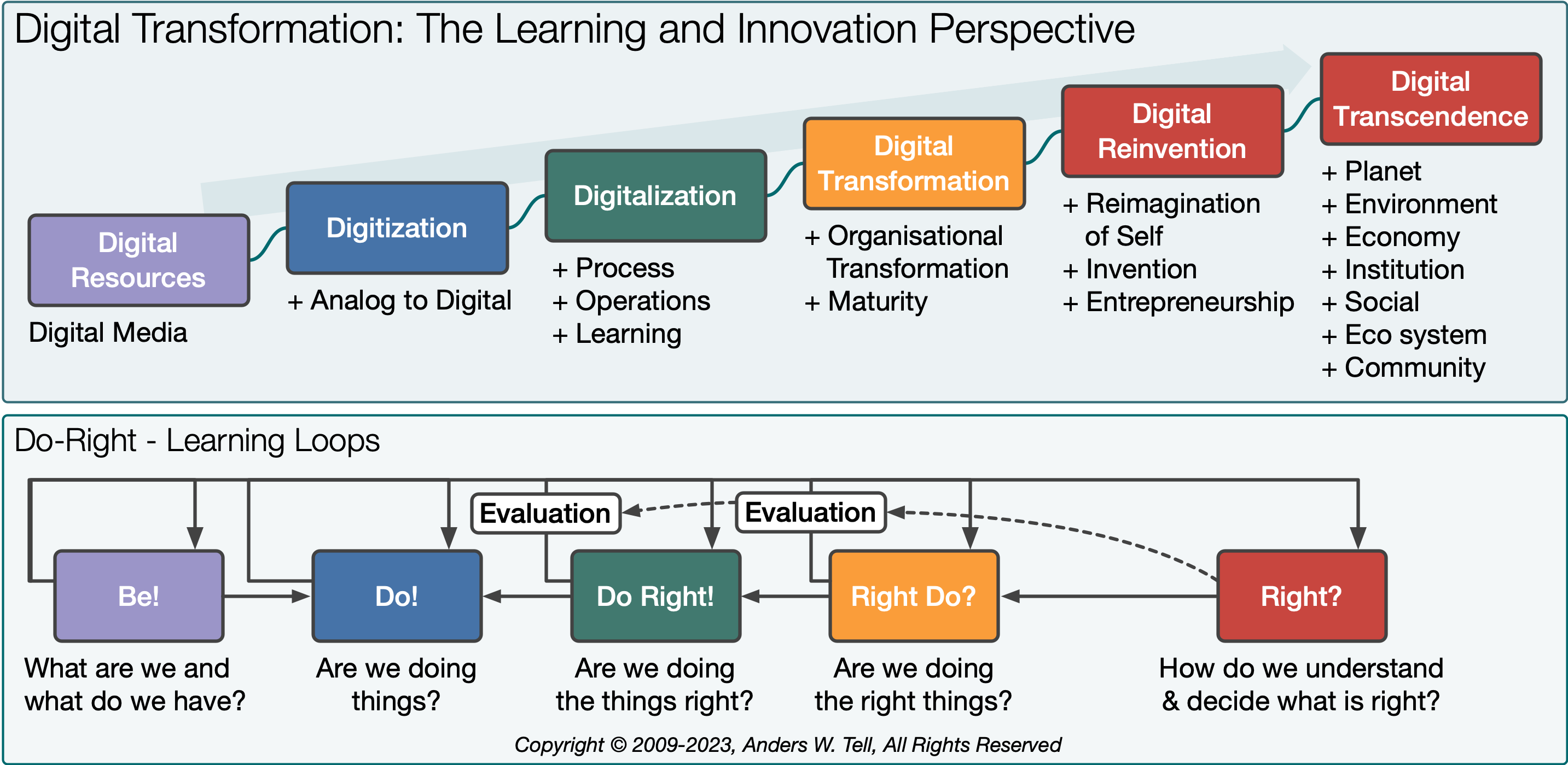
A Learning perspective of Digital Transformations provides a pedagogical tool for discussions about the nature of digital transformation projects. However, many projects include Digitisation, Digitisation, and Digital Transformation elements. This perspective brings to the surface focused definitions of related words and phrases such as digitisatio...
By accepting you will be accessing a service provided by a third-party external to https://www.workem.com/
Discuss an Engagement
If you are navigating a complex transformation, a regulatory architecture challenge, or need senior EA thinking that outlasts the engagement — let's talk.
Explore the Approach
New to Interweaving? Start with how it reimagines Enterprise Architecture for organisations that need architecture to actually work.
Contact:
WorkEm Toolsmiths
info AT workem.com
+46 768 790730
+49 152 2241 0640
Locations:
Munich
Milano